
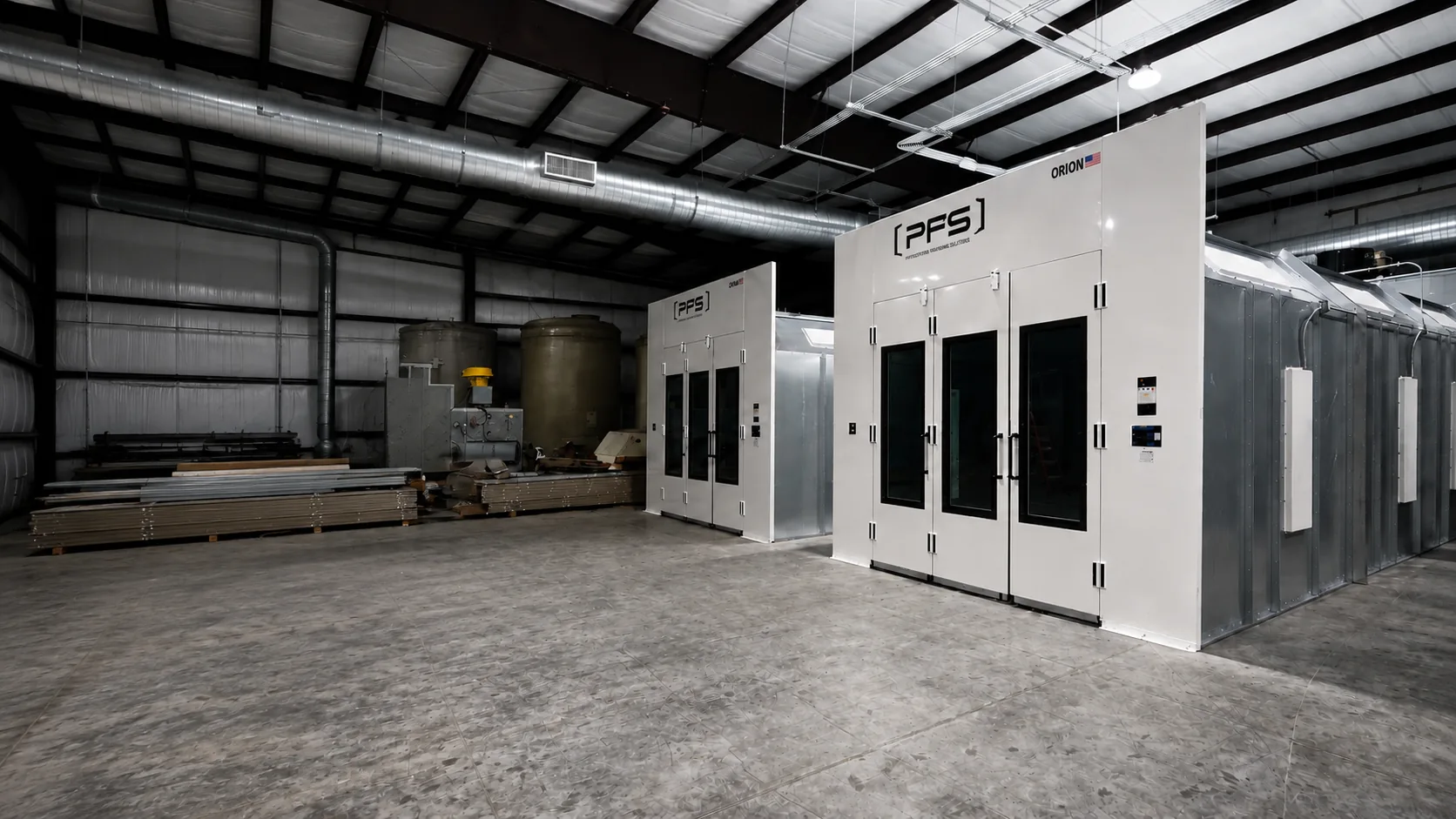
A full downdraft booth draws air straight down from a filtered ceiling plenum and exhausts through a filtered pit in the floor, delivering the cleanest airflow pattern and the best operator breathing zone protection. A semi-downdraft (Orion Series) draws air from the ceiling and exhausts through low side walls, providing near-downdraft quality without requiring a concrete floor pit — ideal for facilities that cannot excavate. A side downdraft (Helios Series) draws air from one side wall and exhausts through the opposite side, requiring no pit and no raised floor system, making it the lowest installed-cost downdraft-style option.
A spray-to-waste powder booth collects overspray in cartridge filters and disposes of it — this is the simpler, lower-cost option and is ideal for operations that run a single color or change colors frequently. A powder reclaim booth uses a reclaim module to collect, sieve, and return overspray powder back into the feed hopper for reuse, significantly reducing material waste and cost per part. PFS offers both configurations.
An abrasive blast room is an enclosed, ventilated structure designed to contain the abrasive media and dust generated during sandblasting or abrasive blasting operations. Blast rooms protect workers and the surrounding environment, allow media recovery and reuse, and maintain OSHA-compliant air quality. PFS Atlas Series blast rooms are custom-engineered to your part size, blast media, and production requirements.
Most powder coatings cure at 350–400°F (177–204°C) for 15–20 minutes at temperature. The exact cure schedule depends on the powder formulation, part mass, and coating thickness. PFS batch ovens are designed to reach and maintain temperatures up to 450°F with excellent temperature uniformity across the work zone.
Yes. PFS offers installation and commissioning services for all PFS equipment. Our field service team can manage the full installation process including site preparation coordination, equipment assembly, utility connections, airflow balancing, and initial startup. Contact us to discuss your project.
150 more of the most-asked questions from our product, industry, integration, service and compliance pages. Open a page to see its questions; each answer links back to the page it comes from, where you will find the rest.
Booth size is driven by the largest aircraft or part you will paint, plus working clearance around it for painters, lifts and equipment, and room to move the aircraft in and out.
Send us the aircraft types you plan to paint, your building or hangar dimensions and your door size, and we will recommend a booth size.
From Aircraft.
Aircraft finishing needs bright, even, shadow-free light from the sides as well as above, with good color rendering, so painters can see film build and defects on curved surfaces. Fixtures in or near the spray area must be rated for the hazardous location or mounted outside it behind sealed panels. Tell us if your coating spec or customers require a specific light level.
From Aircraft. Also answered on Sanding Booths.
NFPA 409 is the standard for aircraft hangars. It groups hangars by size and door height and sets construction and fire protection requirements for each group; larger hangars typically need foam-water or other high-performance protection.
When painting happens inside a hangar, NFPA 409 and NFPA 33 both come into play: the hangar has to meet its own requirements and the spray area has to meet NFPA 33. A self-contained booth inside an existing hangar can keep the spray area defined and controlled. Discuss the plan with your AHJ and insurer early.
From Aircraft.
Spray areas need automatic fire protection over the booth and its exhaust plenum and ducts. Common choices are automatic sprinklers designed to NFPA 13 and, where approved, dry chemical, clean agent or other automatic systems; hangars may add foam-water systems under NFPA 409.
The system is normally designed by a fire protection contractor and approved by your AHJ and insurer. Let us know what is planned so the booth layout accounts for it.
From Aircraft.
Our aircraft booths are designed to support NFPA 33 and EPA NESHAP compliance. Which rules apply to your shop, such as the aerospace NESHAP (40 CFR Part 63 Subpart GG) or the area-source rule 6H (Subpart HHHHHH), depends on your operation and coatings, and your AHJ and air district make the final determination.
Learn more in our NFPA 33 paint booth compliance guide and about NESHAP aerospace filtration.
From Aircraft. Also answered on Dust Collection.
It depends on the largest aircraft or part you will paint, plus working clearance for painters and lifts and room to move the aircraft in and out. Wingspan, length and tail height usually set the envelope. Send us your aircraft types and building dimensions and we will recommend a size.
From Aircraft.
Often, yes. A self-contained booth inside an existing hangar can define and control the spray area without new construction. Hangar height, door size, floor, utilities and the hangar's own NFPA 409 requirements all need to be checked. Send us your hangar dimensions for a review.
From Aircraft.
Downdraft moves air from ceiling to floor and carries overspray away from the aircraft surface, which gives the cleanest finish but needs a pit or raised floor. Crossdraft moves air end to end, costs less and is easier to install in an existing building. Semi-downdraft sits in between. We can help you weigh finish quality, budget and building constraints.
From Aircraft.
Enough to keep flammable vapor far below 25% of the lower flammable limit, as NFPA 33 requires, and to carry overspray away from painters and the finish. Our Zenith downdraft is specified at 100 FPM face velocity. The right airflow for your booth depends on its size, configuration and coatings, and we size it in the quote.
From Aircraft.
Our aircraft booths are designed to support NFPA 33 and EPA NESHAP compliance, including filtration suited to aerospace coatings. Compliance for your facility also depends on installation, fire protection, operation and permits, which your AHJ and air district confirm. See our NFPA 33 compliance guide for details.
From Aircraft.
Lead time depends on booth size, configuration, options and site work such as pits, utilities and permits. We confirm the schedule in your quote. Request a quote with your aircraft types and building details to get a timeline.
From Aircraft.
Cross-Flow Spray Booths page →
The most popular cross-flow booth: horizontal airflow from front intake filters to rear exhaust filters, ETL listed (Intertek) for the USA and Canada, UL 508A controlled, in 9, 10 and 12 ft heights. Details on the Orion cross-flow booth page.
From Cross-Flow Spray Booths.
The same booth with an integrated heating system and programmable spray, flash and bake modes, for faster cure and cold climates. See heated paint booths.
From Cross-Flow Spray Booths.
Extended-height and oversized cross-flow booths for Sprinter vans, box trucks, semi-trucks and heavy equipment. See truck and fleet booths.
From Cross-Flow Spray Booths.
A cross-flow booth built inside an ISO shipping container for remote, military and temporary sites. See container paint booths.
From Cross-Flow Spray Booths.
If finish quality matters more than cost, semi-downdraft, side downdraft or full downdraft airflow moves overspray down and away from the part.
From Cross-Flow Spray Booths.
Standard Orion cross-flow booths are 14 ft wide, 9, 10 or 12 ft high and 24, 27, 30 or 33 ft long. Custom sizes are available.
From Cross-Flow Spray Booths.
Yes. Cross-flow is the most cost-effective enclosed configuration and needs no pit.
From Cross-Flow Spray Booths.
Yes. We provide general arrangement drawings and equipment data to support fire, building and air-quality permitting.
From Custom Paint Booths. Also answered on Large Equipment Outdoor Booths.
Downdraft Raised Basement Booths page →
Heat, air make-up, mixing rooms and prep stations can be added as one coordinated system.
From Downdraft Raised Basement Booths. Also answered on Side Downdraft Booths – Helios Series.
Custom Outdoor Paint Booths page →
From Custom Outdoor Paint Booths. Also answered on Side Downdraft Booths – Helios Series.
Back-wall exhaust filters load up with overspray; watching the pressure gauge and changing filters on schedule keeps airflow and capture steady. Replacement media is available from PFS filters.
From Parts Booths. Also answered on PFS Exhaust Walls Built to Last.
Sprinter Van & High-Clearance Booths page →
From Sprinter Van & High-Clearance Booths. Also answered on Sanding Booths.
Yes. Add a direct- or indirect-fired air make-up unit for spray and bake cycles.
From Sprinter Van & High-Clearance Booths. Also answered on Truck & Large Vehicle Paint Booths.
A spray-to-waste powder coating booth collects overspray in disposable filters and discards it. A powder reclaim booth uses a cartridge recovery system to collect, clean, and recycle overspray back into the application process, reducing material costs significantly in high-volume operations. PFS manufactures both configurations.
From Powder Coating Systems.
Powder coating booth airflow is typically sized between 4,000 and 10,000 CFM depending on booth dimensions, application method, and the specific powder being applied. PFS engineers size each booth to deliver optimal airflow for maximum transfer efficiency and powder containment while meeting NFPA 33 and OSHA requirements.
From Powder Coating Systems.
Yes. Powder coating booths must comply with NFPA 33 and IFC Chapter 24. These standards govern ventilation, electrical classification, fire suppression, and construction requirements. All PFS Nova Series powder coating booths are designed and built to meet or exceed these requirements.
From Powder Coating Systems.
Yes. PFS designs and manufactures both powder coating booths and batch or walk-in curing ovens. We can engineer a complete powder coating line or supply individual components to integrate with your existing equipment.
From Powder Coating Systems.
Powder coating booths are used across automotive manufacturing, heavy equipment, aerospace, transit and rail, architectural aluminum, consumer products, and general industrial manufacturing. PFS has supplied powder coating systems to customers in all of these sectors.
From Powder Coating Systems.
Automated Powder Systems page →
Our engineers are available to help you select the right configuration for your application.
From Automated Powder Systems.
Parts ride a conveyor through the booth while automatic electrostatic guns apply powder from both sides. The guns sit on fixed stands, on reciprocators or gun movers that stroke up and down, or on robots when the part shape changes from hanger to hanger. The booth exhaust pulls overspray away from the part and into a recovery module or a filter bank, and the control panel ties gun triggering, gun motion and booth airflow to the conveyor so the guns only spray when a part is in front of them.
The result is the same film build on part 1 and part 1,000. Operators move from spraying every part to loading, watching the finish and touching up the few surfaces the guns cannot reach.
From Automated Powder Systems.
From Automated Powder Systems.
Fixed guns are the simplest choice for flat or uniform parts on a steady line. Reciprocators and gun movers stroke the guns to cover tall parts with fewer guns, and they can be programmed for different part heights. Robots earn their place when the part mix is wide, the geometry is complex or the same booth has to coat very different parts on one line. Many lines combine them: gun movers for the bulk of the surface and a manual or robotic station for the hard-to-reach areas. See the comparison table on this page and our robotic finishing cells page.
From Automated Powder Systems.
Cyclone and cartridge recovery collect overspray and return it to the feed system, which pays off on long runs of a few colors. Spray-to-waste filtration skips recovery and makes color change faster, which suits short runs and many colors. Some plants use both: a recovery booth for the high-volume colors and a spray-to-waste booth for everything else.
Color change time depends on the booth interior, the guns and hoses, the feed center and whether a recovery circuit has to be cleaned. We plan it against your real color schedule. More detail: powder reclaim systems and spray-to-waste booths.
From Automated Powder Systems.
From Automated Powder Systems.
From Manual Powder Booths. Also answered on Modular Powder Booths.
If parts arrive in mixed sizes and in small runs, a batch oven gives the most flexibility. If the same parts move through pretreatment and a booth on a conveyor, a conveyor oven keeps pace with the line. Many shops start with a batch oven and add a conveyorized line as volume grows.
From Industrial Ovens.
The working chamber has to fit the largest part or rack with room for air to circulate around it. Door type follows from how parts are loaded: carts, fork trucks or vehicles driving in. For conveyor ovens, the length is set by line speed and the time the cure schedule requires.
From Industrial Ovens.
Powder and paint makers publish a cure schedule: a metal temperature and a time at temperature. Most powders cure at a metal temperature of 325°F to 400°F held for 10 to 20 minutes. Heavy, thick parts take longer to reach temperature than thin sheet metal, so the heaviest load you run sets the heat input and cycle time.
From Industrial Ovens.
Natural gas and propane burners give high output at a low operating cost. Electric heat suits sites without gas. Gas catalytic and electric infrared heat the part directly for fast ramp-up and gel or boost stages.
From Industrial Ovens.
Even airflow is what makes every part cure the same. PFS ovens use circulation blowers and ducted air distribution, with UL 508A control panels for temperature control, burner management and safety interlocks. Digital temperature recording is available for quality records.
From Industrial Ovens.
Industrial ovens follow NFPA 86 and the fire code chapter for industrial ovens. That covers ventilation of solvent vapors, burner safety, purge before ignition and over-temperature protection. PFS provides the documentation your authority having jurisdiction needs.
From Industrial Ovens. Also answered on Batch Powder Booths.
Most powders cure at a metal temperature of 325°F to 400°F held for 10 to 20 minutes. Always follow the cure schedule on your powder maker’s data sheet.
From Industrial Ovens.
Batch ovens suit mixed parts and smaller runs. Conveyor ovens suit steady, high-volume production on an automated line.
From Industrial Ovens.
A typical powder line runs pretreatment systems, a dry-off oven, the powder booth and the cure oven, all on one conveyor. See conveyor systems and the full powder coating line.
From Conveyor Ovens. Also answered on Automated Powder Systems.
PFS IR ovens are built with ETL/UL certified components and are NFPA 86 compliant. See all industrial ovens.
From Infrared Ovens. Also answered on Drive-Through Outdoor Booths, Parts Booths.
A blast booth is a smaller, enclosed cabinet or room designed for blasting individual parts or small assemblies. A blast room is a larger walk-in enclosure designed for blasting large parts, structural steel, vehicles, or heavy equipment. PFS manufactures both configurations in standard and custom sizes.
From Blasting Systems. Also answered on Blast Rooms.
PFS Atlas Series blast rooms are compatible with a wide range of abrasive media including steel shot, steel grit, aluminum oxide, glass bead, garnet, and plastic media. The dust collection and media reclaim systems are sized and configured based on the specific media type and blasting volume.
From Blasting Systems.
A media reclaim system captures spent abrasive media from the blast room floor, cleans it to remove dust and fines, and returns reusable media to the blast pot for reuse. Reclaim systems significantly reduce media consumption and disposal costs. They are recommended for any operation using steel shot, steel grit, or other recyclable abrasives.
From Blasting Systems.
Blast rooms require sufficient airflow to maintain visibility during blasting and to capture airborne dust before it escapes the enclosure. OSHA and NFPA standards govern ventilation rates and dust collection requirements. PFS Atlas Series blast rooms are engineered with cartridge dust collectors sized to meet these requirements for the specific media and blasting volume.
From Blasting Systems.
Yes. PFS engineers blast rooms to accommodate virtually any part size or application requirement — including aircraft components, rail cars, structural steel, and heavy equipment. We can design custom door configurations, overhead crane clearances, floor systems, and lighting layouts to meet your specific operational needs.
From Blasting Systems.
Room size, door size and floor loading follow the largest piece you will blast, plus room for the blaster to work around it and for equipment to move in and out.
From Blast Rooms.
Steel grit, steel shot, aluminum oxide and garnet behave differently. Full mechanical recovery collects spent media from the floor, cleans it and returns it to the blast pot, so the media type and throughput set the recovery design.
From Blast Rooms.
The dust collector keeps the room clear enough to see the work and keeps dust out of the plant. OSHA 1910.94 sets the ventilation requirements for abrasive blasting.
From Blast Rooms.
Blast rooms take constant abuse. Heavy-gauge steel panels and abrasion-resistant liners protect the structure where the stream hits.
From Blast Rooms.
Blasters need supplied breathing air, protective gear and good lighting. PFS controls are built to UL 508A, and replacement parts, including breathing-air filters, are available from PFS parts.
From Blast Rooms.
Most blasted parts go straight to coating. Pair the room with powder coating systems or a large equipment oven to finish the job.
From Blast Rooms.
Containerized Blast Booths page →
Military and government contractors, pipeline and infrastructure operators, shipyards and industrial maintenance teams that need to move their blasting capability between sites.
From Containerized Blast Booths. Also answered on Enclosed Work Environments, Drive-Through Outdoor Booths.
A spray booth exhausts a large volume of air to carry overspray and solvent vapor outside. The air make-up unit (AMU) brings the same volume of fresh, filtered air back in. Without it the building goes negative: doors are hard to open, dust and dirt are pulled in through every gap, the booth starves for air and the finish suffers.
From Air Make-Up Units.
The AMU is sized to the booth exhaust in cubic feet per minute (CFM). Booth CFM comes from the booth airflow area and the design air velocity, so a larger booth or a downdraft booth with a full ceiling plenum needs more air. Most booths are balanced slightly positive so clean supply air, not shop air, fills the booth. See our air make-up unit guide for the details.
From Air Make-Up Units.
If the booth runs in cold weather, or the coating needs a stable temperature to flow out and flash, choose heated AMUs. Heating capacity is set by airflow and temperature rise: BTU/h is about 1.08 × CFM × the rise from the coldest outdoor temperature to your setpoint. In mild climates, non-heated AMUs supply fresh outside air at ambient temperature.
From Air Make-Up Units. Also answered on 40-Foot Container Paint Booth, Custom Container Paint Booths, High-Cube Container Paint Booth.
By the booth exhaust CFM, and for heated units by the temperature rise from your coldest outdoor design temperature to the booth setpoint. Send us the booth size and type and your location and we will size it.
From Air Make-Up Units. Also answered on Non-Heated.
Heated if the booth runs in cold weather or the coating needs a controlled temperature. Non-heated where the climate is mild and tempered air is not needed. A non-heated unit can be ordered with heat added.
From Air Make-Up Units. Also answered on Non-Heated.
Natural gas, propane and electric. Gas units are available as direct-fired or indirect-fired.
From Air Make-Up Units. Also answered on Industrial Ovens.
Apollo units are commonly installed on the roof above the booth, with ductwork routed down to the booth intake plenum. PFS reviews the site, duct path and utilities as part of sizing.
From Non-Heated. Also answered on Custom Outdoor Paint Booths.
Custom CFM sizing matches the unit to the booth exhaust so the booth runs at the right pressure. Send us your booth size and type.
From Non-Heated. Also answered on Manual Powder Booths.
A complete spray booth built inside a standard 20 ft or 40 ft ISO shipping container, with lighting, intake and exhaust filtration, an air supply plenum, classified electrical and a control panel. It ships ready to set in place.
From Container Booths.
It is mobile and self-contained. Container booths suit remote sites, temporary or leased facilities, military and field operations, and shops without room for a permanent booth.
From Container Booths.
Standard 20 ft and 40 ft containers, high-cube containers for extra height, and custom configurations.
From Container Booths. Also answered on Process Controlled Rooms, Open Face Paint Booths, PFS Exhaust Walls Built to Last.
Yes. Heated air make-up options are available for cold climates and cure cycles.
From Container Booths.
Usually, yes. Fire, building and air-quality authorities review them like any spray booth. PFS supplies drawings and equipment documentation.
From Container Booths.
20-Foot Container Paint Booth page →
The 20-ft container is the most compact and mobile PFS spray booth: parts, components, touch-up work and small equipment, at job sites, remote locations, forward operating bases and facilities that cannot add a permanent booth.
A container booth still needs a level, solid surface, electrical power, compressed air for the spray guns and a clear path for exhaust. Because it is a spray booth, the local fire code and air district rules still apply; ask your authority having jurisdiction early. See our NFPA 33 guide.
From 20-Foot Container Paint Booth. Also answered on 40-Foot Container Paint Booth, Custom Container Paint Booths, High-Cube Container Paint Booth.
NFPA 33 sets specific limits for rooms used to mix flammable and combustible liquids. They include a maximum floor area of 150 sq ft, an enclosed room with spill containment, a cap on the liquid kept inside of 2 gallons per sq ft, and mechanical ventilation of at least 1 cfm per sq ft or 150 cfm (whichever is greater) running whenever the room is in use. They also require electrical classification, automatic fire protection, and portable extinguishers. Your local fire official makes the final call, so confirm the requirements for your jurisdiction.
From Mixing Rooms.
Start with how much paint you mix and keep on hand. The MR6 suits a single-booth shop; the MR12 and MR15 add bench space, storage racks and room for a mixing system. All four standard models stay under the 150 sq ft limit.
From Mixing Rooms.
Mixing rooms usually sit directly beside the booth so painters walk a few steps, not across the shop. They can stand alone or integrate with the booth wall and share its exhaust.
From Mixing Rooms.
Tube-axial fans with a 12" exhaust duct keep air moving through filtered intake and exhaust, and the controls interlock ventilation with lighting and the shop’s fire protection.
From Mixing Rooms. Also answered on NFPA 33 Paint Booth Compliance.
Class I Division 2 light fixtures give accurate color matching, and the electrical inside the room is specified for its hazardous classification.
From Mixing Rooms.
An industrial paint mixing room provides a dedicated, code-compliant space for paint preparation, thinning, color matching, straining, and storage of flammable liquids. Continuous cross-flow ventilation removes paint and solvent fumes, keeping the environment safe for workers and compliant with OSHA, NFPA 33, and local fire codes.
From Mixing Rooms.
Yes. Paint mixing rooms used for the preparation and storage of flammable coatings are subject to NFPA 33 requirements. PFS mixing rooms are built to NFPA 33 standards with ETL/UL listed and certified components, OSHA compliant cross-flow ventilation, and a built-in 4-inch containment base for spill capture.
From Mixing Rooms.
An integrated mixing room is built as part of the spray booth system — sharing a common wall with the booth and delivered as a single unit. A stand-alone mixing room is a self-contained unit that can be placed anywhere in your facility. PFS manufactures both configurations. Integrated rooms offer the advantage of single-source delivery, installation, and accountability.
From Mixing Rooms.
Yes. PFS manufactures mixing rooms in standard and custom sizes. Standard configurations range from 8' x 8' to 12' x 16', but custom dimensions are available for non-standard facility layouts. Contact a PFS engineer for a custom quote.
From Mixing Rooms.
Many sanding dusts, including fillers, composites, wood and metals, can be combustible. NFPA 652 calls for a dust hazard analysis (DHA) for processes that make combustible dust, and dust from aluminum, magnesium or titanium falls under NFPA 484. PFS can size the collection system around your DHA.
From Sanding Booths. Also answered on Dust Collection.
Controls hold the setpoints, raise alarms when conditions drift and can record temperature and humidity for quality records. PFS builds control panels in-house to UL 508A.
From Environmental Rooms. Also answered on Custom Environmental Rooms.
If flammable coatings or solvents are used or stored inside, the room design must also meet the fire code and electrical classification for that use. Tell us what will be inside the room so it is engineered for it.
From Environmental Rooms. Also answered on Custom Environmental Rooms, Enclosed Work Environments.
Custom Environmental Rooms page →
Custom rooms can be tied into automated finishing systems, conveyors and booths so the environment and the process run together.
From Custom Environmental Rooms. Also answered on Custom Industrial Ovens.
Many needs are met by temperature-controlled rooms, process-controlled rooms or enclosed work environments. Custom rooms cover what those do not.
From Custom Environmental Rooms. Also answered on Custom Outdoor Paint Booths.
Full installation support is available, with in-house engineering from Santa Rosa, CA.
From Custom Environmental Rooms. Also answered on Custom Outdoor Paint Booths.
Integration & Automation page →
List the parts you will run, the largest and heaviest, the mix and the parts per hour or shift you need. Those numbers set the conveyor speed and hanger spacing, and from there the size of every washer stage, booth and oven on the line.
From Integration & Automation.
Powder suits durable finishes on metal with high material use and few VOCs. Liquid suits heat-sensitive parts, very thin films, special colors and many substrates. Some plants run both. See liquid paint lines and powder coating lines.
From Integration & Automation.
Most coating failures start with poor surface preparation. pretreatment systems clean the metal and apply a conversion coating before paint or powder; blasting handles scale and rust when parts need it.
From Integration & Automation.
Overhead monorail, power-and-free and floor conveyor systems carry parts through every stage. Power-and-free lets carriers stop, queue and switch paths when stages run at different rates.
From Integration & Automation.
Automatic guns, reciprocators and robotic finishing cells give the same coverage on every part and free operators to load, inspect and touch up.
From Integration & Automation.
PFS builds UL 508A control panels in-house. PLC-based controls coordinate the conveyor, guns, booth airflow, washer and oven temperatures, interlocks and alarms from one operator screen.
From Integration & Automation.
Not every project starts from an empty floor. system integration connects new booths, ovens or conveyors to the equipment, controls and utilities already in your plant.
From Integration & Automation.
Booths follow NFPA 33, ovens NFPA 86, and automated powder systems need flame detection with automatic shutdown. PFS provides the drawings and documentation for permits, then installs, starts up and commissions the line with your team.
From Integration & Automation.
PFS designs, engineers, manufactures and installs the whole finishing system, from pretreatment to the curing oven, so every stage is sized to work together and one team is accountable for the result.
From Integration & Automation.
Often, yes. We review the existing conveyor, booth airflow, controls and utilities, then integrate new equipment such as automatic guns, robots or a new oven.
From Integration & Automation.
California & West Coast Paint Booth Filters page →
A facility’s permit conditions and coating process can affect what it documents about its booth and filtration. PFS can help match intake and exhaust media to the booth configuration and provide available manufacturer information; the facility and its regulatory advisors determine the complete permit or compliance approach.
The appropriate filter depends on the booth configuration, airflow direction, coating process, and the facility’s permit conditions. PFS can help identify intake, ceiling, exhaust, pocket bag, or accordion paint arrestor media for the booth and discuss the available product documentation.
CARB is the California Air Resources Board. California coating operations may also work with local air districts and permit conditions. PFS can help identify media options and manufacturer information relevant to the booth; facility owners should confirm their specific regulatory requirements with the appropriate authority or advisor.
Yes. PFS supplies replacement filters for all major booth brands operating in California — including Binks, DeVilbiss, Global Finishing Solutions, Garmat, Col-Met, and others. Call or email with your booth model and we will identify the correct filter dimensions and media type.
PFS manufactures in Santa Rosa, CA. Most California orders ship the same or next business day. Delivery times vary by destination, but most California addresses receive orders within 1–3 business days. We also offer scheduled delivery programs for shops with regular replacement needs.
Yes. PFS offers bulk pricing for California shops, dealership groups, and multi-location operators. We also offer scheduled delivery programs so you never run out of filters during a busy production period. Contact our parts team for volume pricing.
Yes. PFS is an authorized Andreae filter distributor and can help California and West Coast shops identify an accordion-style paint arrestor or other exhaust media using the current filter model, dimensions, booth configuration, and a photo of the existing media.
NESHAP aerospace Compliance page →
NESHAP Subpart GG can be relevant to aerospace rework operations using certain coating processes. The complete filter configuration, coating process, and available manufacturer documentation should be reviewed by the facility and its advisors. PFS can help identify media options and product information for that review.
EPA Method 319 is a referenced test method for evaluating paint spray booth filter capture data. PFS can help request available manufacturer test information for the media being considered; the facility determines whether the documentation meets its needs.
Yes. PFS supplies filtration media for all major spray booth brands — including Binks, DeVilbiss, Global Finishing Solutions, Garmat, Col-Met, and others. If your booth uses a standard filter size, we can supply it.
From NESHAP aerospace Compliance. Also answered on Paint Booth Filters.
Replacement intervals depend on coating volume, filter loading, booth airflow, the manufacturer’s guidance, and the facility’s own program. PFS can help create a practical replacement discussion using the current media and booth configuration.
PFS can help request available filter specification sheets and manufacturer product information for the media being considered. The facility and its advisors decide how that information is used in its records.
Yes. PFS offers bulk pricing and scheduled delivery programs for facilities with ongoing filter replacement needs. Contact our parts team for volume pricing and blanket order arrangements.
PFS evaluates the complete filter configuration, documented manufacturer data, coating process, and facility requirements before recommending any exhaust media for a regulated application. If you currently use Andreae accordion media, send the filter model, dimensions, and application details so we can help review the proposed replacement.
Filter replacement intervals depend on coating volume, paint type, and filter loading. Most auto body shops replace exhaust floor filters every 1-4 weeks depending on production volume. Ceiling diffusion blankets typically last 3-6 months. The best indicator is pressure differential — when the pressure drop across the filter bank exceeds the booth manufacturer's specified range, it's time to replace. PFS can help you establish a documented maintenance schedule.
From Paint Booth Filters.
Using the wrong filter — wrong dimensions, wrong efficiency rating, or wrong media type — can cause several problems: inadequate overspray capture leading to contamination, excessive pressure drop reducing airflow and finish quality, filter collapse or blowout under high velocity, and failed compliance inspections. Always match filter specifications to your booth manufacturer's requirements.
From Paint Booth Filters.
We service C1D1 and C1D2 classified enclosures across a wide range of applications — including chemical processing, pharmaceutical manufacturing, industrial flammable-storage, oil and gas processing, battery energy storage, and clean room environments. Our technicians service explosion-proof fans, motors, controls, gas detection systems, and ventilation interlocks regardless of the original manufacturer.
From Hazardous Location.
We specialize in RKI Instruments and Honeywell fixed gas detection systems, which are among the most widely deployed in industrial hazardous location applications. Calibration is performed using traceable calibration gas referenced to NIST standards, and every calibration is documented with a timestamped certificate.
From Hazardous Location.
Most regulatory authorities and equipment manufacturers recommend calibration at least annually, with bump testing more frequently depending on the application. OSHA 1910.307 and NFPA 70 Article 500 require that gas detection equipment in classified locations be maintained in proper working condition. In practice, many facilities calibrate quarterly to maintain insurance compliance and to catch sensor drift before it becomes a safety issue.
From Hazardous Location.
Yes. Every service visit produces a complete documentation package: airflow measurements, calibration certificates with traceable calibration gas references, equipment condition photographs, maintenance records, and a written summary of findings and corrective actions. This documentation is formatted to meet OSHA, NFPA, and state fire authority inspection requirements.
From Hazardous Location. Also answered on POWDER RECLAIM SYSTEM SERVICE, SPRAY-TO-WASTE POWDER BOOTH SERVICE.
Yes. We offer annual and multi-year preventive maintenance contracts covering scheduled gas sensor calibration, ventilation system testing, controls inspection, and compliance documentation. Contracts are available for single facilities and multi-site operators. Priority emergency response is included for contract customers.
From Hazardous Location.
Yes. We service the underlying safety systems — explosion-proof fans, motors, gas sensors, PLCs, and ventilation interlocks — regardless of who manufactured the enclosure. Our technicians work at the component level and are familiar with the NEC Article 500, NFPA, and OSHA standards that govern all classified location equipment.
From Hazardous Location.
We provide hazardous location and critical environment services nationwide. Service fees are quoted per visit; travel and lodging are billed at cost for locations outside our primary service area in Northern California. Contact us to discuss scheduling and coverage for your facility.
From Hazardous Location. Also answered on POWDER RECLAIM SYSTEM SERVICE, SPRAY-TO-WASTE POWDER BOOTH SERVICE.
POWDER RECLAIM SYSTEM SERVICE page →
We service all powder reclaim system configurations — including cyclone-based recovery systems, after-filter cartridge systems, and fully automated conveyor-integrated powder coating lines. We service PFS-manufactured systems and third-party units. Our technicians work at the component level and are familiar with the NFPA 33 and NFPA 654 standards that govern all powder coating operations.
After-filter cartridge service intervals depend on production volume, powder type, and the pulse-jet cleaning cycle effectiveness. We recommend inspecting filter condition and measuring static pressure drop at every PM visit and replacing cartridges when pressure drop exceeds the manufacturer's specification or when visual inspection reveals media damage. In high-volume operations, quarterly inspection is standard.
Yes. We service the underlying systems — cyclone separators, after-filters, ventilation, controls, and grounding — regardless of who manufactured the system. Our technicians are familiar with the NFPA 33 and NFPA 654 standards that govern all powder coating and reclaim operations.
A spray-to-waste booth captures overspray powder in a filter system and disposes of it — the powder is not recovered for reuse. A powder reclaim system uses a cyclone separator to capture overspray and return it to the feed hopper for reuse, significantly reducing material waste and operating cost. Reclaim systems are more complex mechanically and require more comprehensive maintenance to maintain recovery efficiency.
SPRAY-TO-WASTE POWDER BOOTH SERVICE page →
We service all spray-to-waste powder booth configurations — including three-stage panel filter systems and pulse-jet cartridge filter systems. We service PFS-manufactured booths and third-party units. Our technicians work at the component level and are familiar with the NFPA 33 and OSHA 1910.94 standards that govern all powder coating booth operations.
Filter replacement intervals depend on production volume, powder type, and the filter system design. Panel filters in three-stage systems typically require inspection every 40–80 production hours and replacement when static pressure drop exceeds the manufacturer's specification. Pulse-jet cartridge filters have longer service intervals but require periodic inspection for media damage and seal integrity. We assess your specific operation and recommend a replacement schedule during the initial service visit.
NFPA 409 is the standard for aircraft hangars. It groups hangars by size and door height and sets construction and fire protection requirements for each group. When painting happens in a hangar, the spray area also has to meet NFPA 33, so both standards apply. Read our NFPA 33 compliance guide and involve your AHJ and insurer early.
From Aerospace & Defense.
A booth can be built as a self-contained insert inside an existing hangar or building, so the spray area is defined and ventilated without new construction. Hangar height, door size, floor, utilities and fire protection all need to be checked first. Send us your hangar dimensions and the aircraft you paint for a review.
From Aerospace & Defense.
Aerospace primers and topcoats are usually specified for a temperature and humidity range during application and cure. Heated make-up air holds booth temperature, and humidity control can be added where the coating requires it. Tell us your coating system so the air handling is sized to it.
From Aerospace & Defense. Also answered on Aircraft.
Aerospace finishing operations are subject to NFPA 33 (Standard for Spray Application of Flammable or Combustible Materials), OSHA 1910.94 (Ventilation), and applicable FAA, NADCAP, and Boeing/Airbus supplier quality requirements. PFS aerospace booths are built to NFPA 33 and OSHA standards with ETL/UL listed and certified components. NADCAP and OEM-specific requirements are addressed during the engineering phase.
From Aerospace & Defense.
Aerospace spray booths range from small component booths (10 ft wide x 10 ft deep) for avionics and small parts to full-aircraft booths exceeding 100 ft wide x 200 ft deep for wide-body commercial aircraft. PFS engineers size each booth to the specific aircraft or component type, production volume, and coating process requirements.
From Aerospace & Defense.
Automotive Manufacturing page →
From Automotive Manufacturing. Also answered on Collision Repair & Auto Body, Energy Utilities, Government & Military, Heavy Equipment and 4 more.
PFS booths ship with ETL-listed electrical packages, and we provide the drawings and data your permit packet needs. Requirements vary by jurisdiction, so confirm with your authority having jurisdiction. See our NFPA 33 guide.
From Automotive Manufacturing. Also answered on Collision Repair & Auto Body, Energy Utilities, Heavy Equipment, Industrial Manufacturing and 3 more.
Every PFS booth is built with ETL/UL listed components and engineered to NFPA 33, the NEC (Article 516) and OSHA 1910.107. Your local fire marshal and air district have the final say, so we supply drawings, airflow data and cut sheets for permitting. See our NFPA 33 compliance guide for the details.
From Automotive Manufacturing. Also answered on Energy Utilities, Government & Military, Heavy Equipment, Industrial Manufacturing and 3 more.
To quote quickly, send us: vehicle or part envelope (L × W × H) and how it moves through the plant; the door opening you need; your building footprint, ceiling height and power; the coatings you spray; and how many units per day or week you finish. Photos of the space help.
From Automotive Manufacturing. Also answered on Collision Repair & Auto Body, Education, Energy Utilities, Government & Military and 8 more.
PFS booths use ETL/UL listed components and are built to NFPA 33, the NEC and OSHA 1910.107.
From Energy Utilities. Also answered on Government & Military, Rail Transit.
From Heavy Equipment. Also answered on Woodworking.
Tall machines need lighting at every level and safe access. We plan man-lifts, fixed platforms and side lighting so painters can reach the top of the machine without shadows.
From Heavy Equipment. Also answered on Rail Transit.
cross-flow is the most economical choice for large equipment. semi-downdraft booths improve finish quality without a pit. full downdraft gives the best finish when OEM-spec quality is required.
From Heavy Equipment. Also answered on Truck, Bus & Fleet.
Industrial Manufacturing page →
heated booths and cure ovens speed up cure for epoxies and urethanes and keep coatings in spec in cold weather.
From Industrial Manufacturing. Also answered on Large Equipment Outdoor Booths, Truck & Large Vehicle Paint Booths, Prep Stations.
Rail cars are tall and long. Multi-level platforms, side lighting and roof access are planned into the booth from the start so painters can reach every surface safely.
From Rail Transit. Also answered on Truck, Bus & Fleet.
Most California booth projects go through the air district for the air permit, the local fire marshal or building department for the California Fire Code and building permit, and an electrical review. Each looks at different documents, so plan for all three from the start.
From California.
The 2025 California Building Standards Code (Title 24) took effect January 1, 2026. Spray finishing falls under California Fire Code Chapter 24, which is based on the 2024 International Fire Code, and booth wiring under the California Electrical Code. Cal/OSHA Title 8 covers spray coating ventilation and worker safety. See our California permitting guide and NFPA 33 guide.
From California.
PFS is headquartered at 1400 Airport Blvd in Santa Rosa, where every booth is designed, fabricated and assembled. PFS service technicians cover Northern California, including the Bay Area, Sacramento Valley, North Bay and Solano County, and PFS supports installations and major projects throughout the state, including Los Angeles County and the Central Valley. Services include preventive maintenance, NFPA 33 inspections with written reports, installation services and replacement filters and parts, for PFS equipment and other makes.
From California. Also answered on Central Valley, Inland Empire, San Diego.
Inland summers are hot and desert nights can be cold. Size the air make-up unit for both, and consider heated airflow for winter cure times. See our AMU guide.
From Inland Empire. Also answered on Drive-Through Outdoor Booths.
Yes. Every photo on this page shows a booth, oven, blast system or support unit built by Platinum Finishing Systems. No renders or stock images.
From Recent Projects.
Yes. Most projects start from a standard PFS model and are sized and configured for the parts, building and code requirements of the shop. Request a quote and tell us which project is closest to what you need.
From Recent Projects.
Enclosed and open-face paint booths, truck and large-vehicle booths, industrial curing ovens, blast booths and rooms, prep stations, mixing rooms and air make-up units, plus the controls, installation and service that go with them.
From Recent Projects.
PFS crews install booths and support equipment, and our service team supports the system after start-up with preventive maintenance, inspections and parts. See Service for details.
From Recent Projects.
For the complete warranty terms, return policy, freight policy, and legal notices, see the PFS Legal & Policies page.
Our engineering team is available to answer technical questions about spray booths, powder coating systems, blast rooms, and ovens.