
Fully integrated powder coating lines including pretreatment, application, and curing.

PFS designs and builds complete turnkey powder coating lines for metal fabricators, automotive suppliers, agricultural equipment manufacturers, and custom coating operations. As a single-source manufacturer, we engineer every stage of the powder coating process — from the pretreatment wash system through the powder application booth, powder recovery system, and curing oven — into a seamlessly integrated production line. Our systems accommodate standard TGIC polyester, epoxy, epoxy-polyester hybrid, and specialty powder chemistries.Talk to a PFS systems engineer about your integration project.
Powder delivery precision is the difference between a consistent finish and a costly rework cycle. PFS integrates dense phase powder pump technology, Venturi pump systems, and powder center configurations that deliver stable, consistent powder flow to every gun on the line. Closed-loop digital flow control maintains powder output stability across shifts and color changes. Our color change systems — from manual to fully automated — are engineered for contamination-free color change with minimal purge time, protecting your production schedule and reducing material waste. Production monitoring dashboards give line supervisors real-time visibility into gun output, recovery efficiency, and oven temperature profiles.
PFS powder coating lines are installed in facilities across the United States, handling everything from small architectural components to large structural steel assemblies. Conveyor configurations include overhead monorail, power-and-free, and floor-mounted systems, all engineered to your part load, line speed, and facility layout. Our systems are engineered to NFPA 33 standards and ETL/UL listed, with PLC-based controls that manage conveyor speed, powder gun parameters, oven temperature profiles, and color change sequences from a single HMI touchscreen.
| Factor | Batch powder system | Conveyorized powder coating line |
|---|---|---|
| How parts move | Loaded on carts or racks, coated and cured in groups | Hung on a conveyor that runs through every stage |
| Best for | Low volume, high mix, large or one-off parts, job shops | Steady volume of repeat parts |
| Pretreatment | Wash booth or manual cleaning | Multi-stage spray washer with dry-off oven |
| Application | Manual booth (spray-to-waste or reclaim) | Automatic guns, gun movers or robots plus manual touch-up |
| Cure | Batch or walk-in oven | Conveyor oven sized to line speed and part mass |
| Labor per part | Higher | Lower |
| Flexibility | Highest; any part, any order | Best with planned part families and color schedules |
| Floor space | Smaller | Larger; the conveyor loop sets the layout |
A typical line runs in a loop: load, pretreatment wash, dry-off oven, cool-down, powder booth, cure oven, cool-down and unload. Some lines add a blast stage before the washer for heavy scale or rust, a manual prep or masking area, or a second booth for a second coat or color. Every stage shares one conveyor, so line speed and hanger spacing set the size of everything else.
Parts per hour = line speed (feet per minute) × 60 ÷ hanger spacing (feet) × parts per hanger. That number, with the largest part and its weight, sizes the conveyor, the washer stage lengths, the oven length (dwell time = oven conveyor length ÷ line speed) and the gun count in the booth. Tell us your parts, the mix and the shifts you run and we work backwards from your target.
Pretreatment cleans the metal and leaves a conversion coating so the powder bonds and resists corrosion. PFS spray washers come in 3-stage, 5-stage and 7-stage designs. Fewer stages combine cleaning and conversion in one step; more stages separate cleaning, rinsing and conversion for tighter control. The right choice follows the substrate (steel, galvanized, aluminum), the soils on the parts and the corrosion performance your customers specify. See pretreatment systems.
Long runs of a few colors favor powder reclaim, where overspray is collected and reused. Many colors and short runs favor spray-to-waste booths with fast color change. Lines often combine automatic guns with a manual touch-up station, or use automated powder booths with gun movers or robots for repeat parts.
The dry-off oven removes rinse water before powder. The cure oven brings the part metal to the temperature in the powder maker’s cure schedule and holds it there for the required time. Heavy parts take longer to heat than thin sheet metal, so part mass matters as much as line speed when sizing the oven. Lines are cured in conveyor ovens; low-volume or oversized work can use batch ovens alongside the line.
It depends on the metal, the soils on the parts and the corrosion performance you need. PFS builds 3-stage, 5-stage and 7-stage washers. Send us your substrates and the coating spec your customers require and we will recommend a stage count.
From the powder maker’s cure schedule, the line speed and the heaviest part. Dwell time is the oven conveyor length divided by line speed, and heavy parts need more time to reach metal temperature, so we size the oven from your real part mix.
Gas or electric heat for the washer and ovens, electrical service, clean dry compressed air for the guns and recovery, a water supply and a plan for wastewater. We list the loads for each stage in the proposal.
Yes. Planning the floor space, oven location and conveyor path early makes it easier to add a washer, conveyor and automatic guns as volume grows.
Yes. PFS designs, fabricates, installs and commissions the complete line, including the controls, so you have one point of accountability from pretreatment to cure.
A line where parts ride a conveyor through pretreatment, the dry-off oven, the powder booth and the conveyor cure oven. Automatic guns, or gun movers and robots for repeat parts, do the spraying, often with a manual touch-up station. PFS designs, installs and commissions the complete line, controls included.
Parts per hour = line speed (feet per minute) × 60 ÷ hanger spacing (feet) × parts per hanger. That number, with the largest part and its weight, sizes the conveyor, the washer stages, the conveyor oven length and the gun count in the booth.
An overhead monorail is a continuous loop at one speed, the simplest and most common choice for steady production. Power-and-free carriers can stop, queue and switch paths, so stages can run at different rates. Floor conveyors carry very heavy or large parts. See conveyor systems.
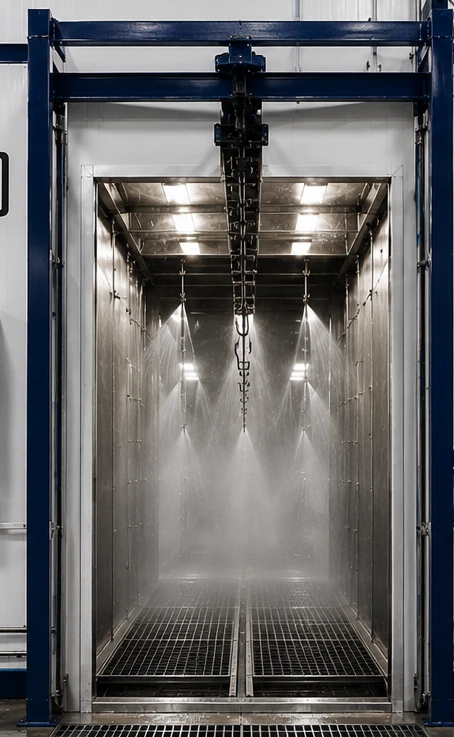
Automated chemical pretreatment systems for cleaning, phosphating, and surface prep before coating.
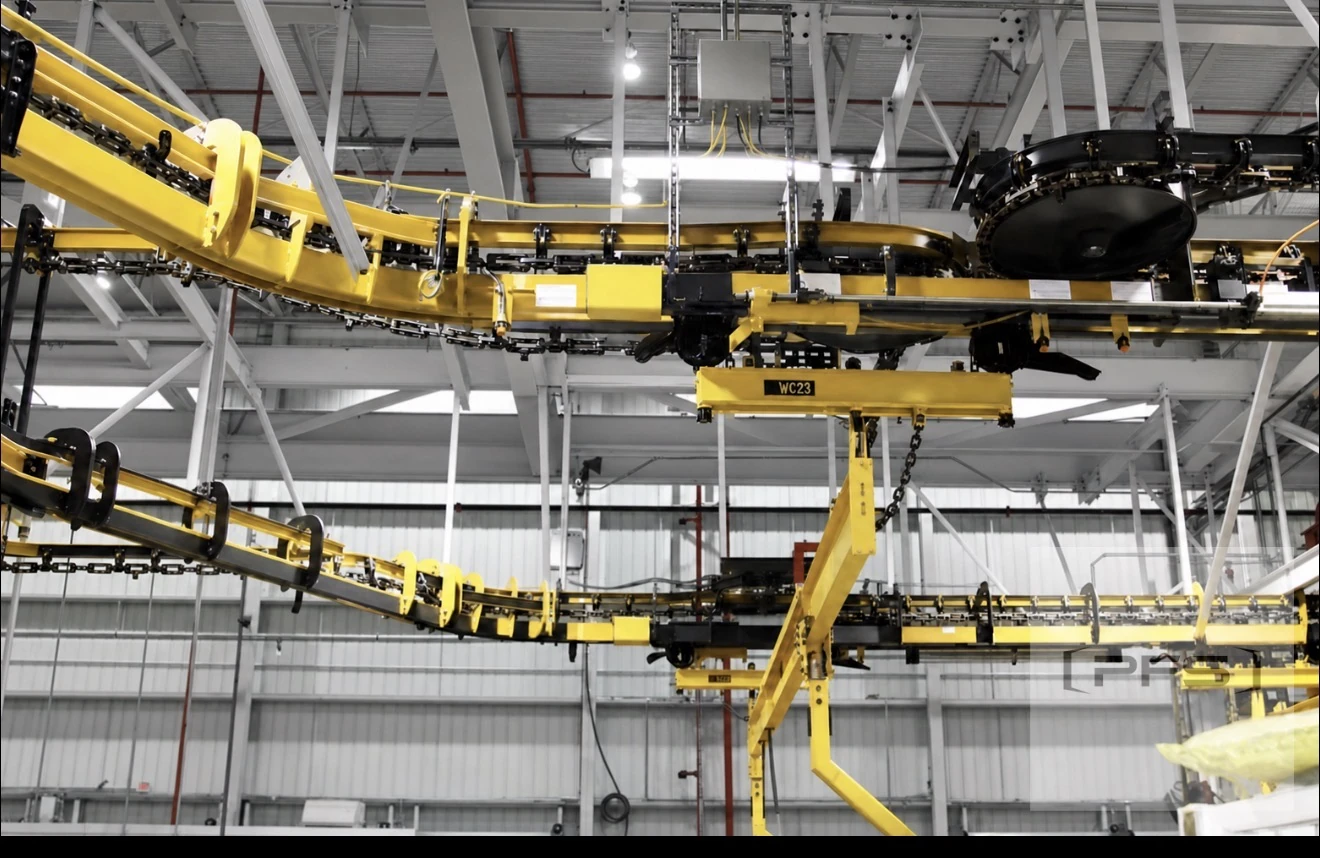
Overhead monorail, power-and-free, and floor conveyor systems for industrial finishing lines.
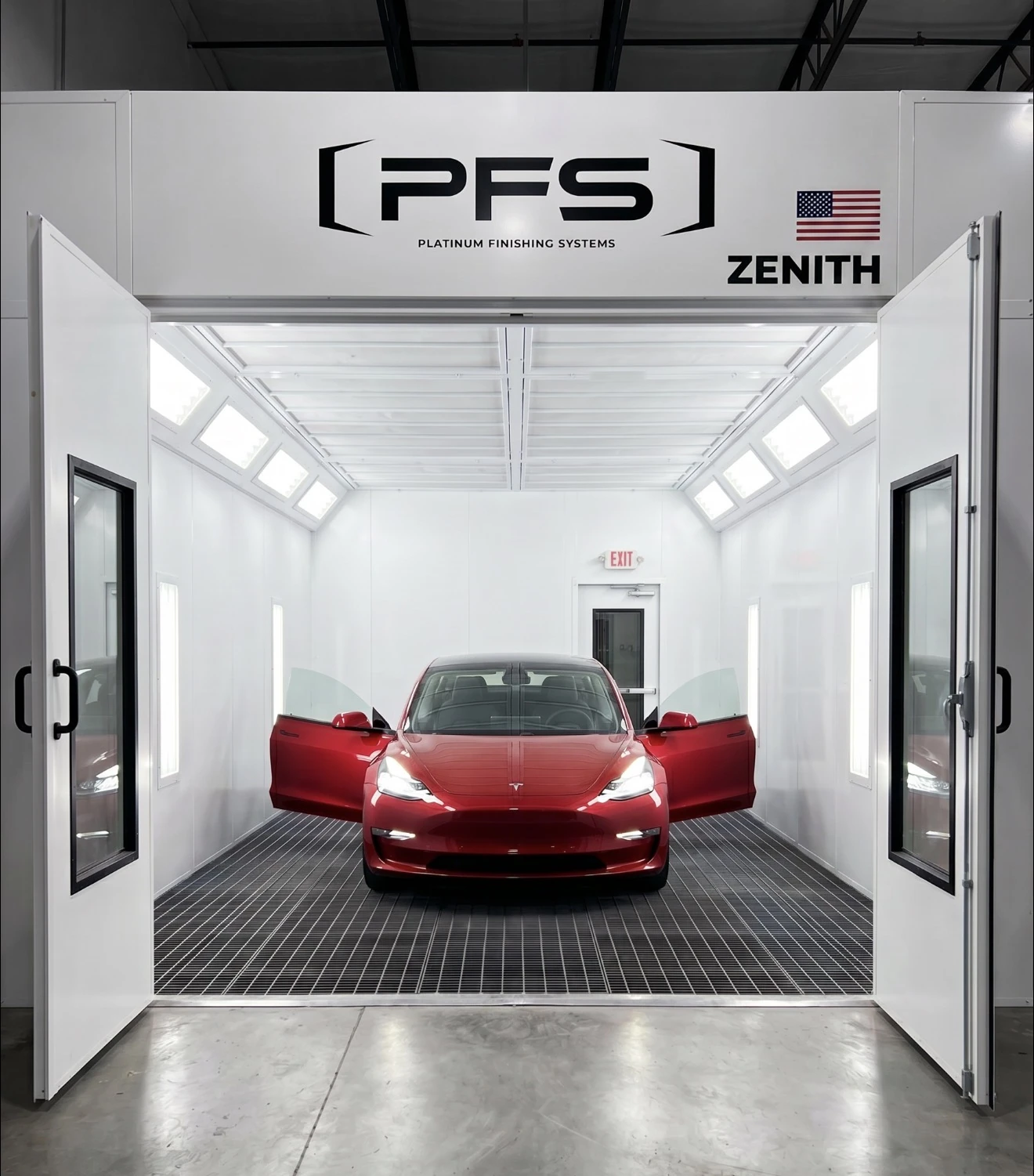
Full-enclosure booths for superior overspray containment and finish quality.


