

Robotic finishing cells deliver consistent, repeatable coating application with reduced material consumption, lower labor costs, and improved finish quality compared to manual spray operations. PFS designs and integrates complete robotic finishing cells — the cell enclosure, robot interface, end-of-arm tooling, spray or powder applicator, booth integration, conveyor interface, and safety systems — working with leading industrial robot suppliers to deliver turnkey automated finishing cells that run at production speed with minimal operator intervention. PFS is a robot brand agnostic integrator: we specify and integrate the robot platform that best fits your application, production volume, and budget.Talk to a PFS systems engineer about your integration project.
The business case for robotic finishing is compelling. Robotic applicators equipped with high-speed rotary atomizers, bell cup applicators, or electrostatic spray guns apply coating at consistent film thickness across every part, every cycle — eliminating the variability inherent in manual spray operations. Transfer efficiency improvements of 20–40% are achievable with rotary atomizer technology compared to conventional air spray. Material savings of 15–30% are common when converting from manual to robotic application, due to the elimination of overspray from inconsistent technique. Robotic cells also eliminate operator exposure to coating materials and solvents, improving workplace safety and reducing PPE costs. Offline robot programming and path simulation allow new part programs to be developed and validated without taking the production cell offline.
PFS robotic finishing cells are engineered as complete, explosion-proof systems for Class I Division 1 and Division 2 hazardous locations per NFPA 33. The cell enclosure, robot mounting, color change valve manifold, fluid delivery system, and safety systems — light curtains, area scanners, safety-rated door interlocks, and emergency stops per ANSI/RIA R15.06 — are all designed and integrated by PFS. We provide robot path programming and simulation, production monitoring and data logging, and operator training as part of every robotic cell project. Our systems are designed for easy reprogramming when part geometry changes, protecting your investment as your product line evolves.
Platinum Finishing Systems (PFS) integrates FANUC and ABB robots in its robotic finishing cells and finishing lines, and stays robot brand agnostic so the platform fits your application.
The Orion-R pairs robotic spraying with the PFS Orion Open Face Series booth. Platinum Finishing Systems (PFS) showed it at FABTECH 2026, Booth S13053, with a FANUC paint-spraying robot. The open front lets large and irregularly shaped parts be loaded without disassembly, and a robotic cell can sit on a line with conveyors, pretreatment and cure ovens.
Yes. Liquid cells can use high-speed rotary atomizers, bell cup applicators, electrostatic guns, HVLP, airless or air-assisted airless applicators, with color change valve manifolds. Powder cells use electrostatic guns with corona or tribo charging.
Yes. PFS builds explosion-proof cell enclosures rated for Class I Division 1 and Division 2 hazardous locations per NFPA 33, with custom end-of-arm tooling and gun mounting.
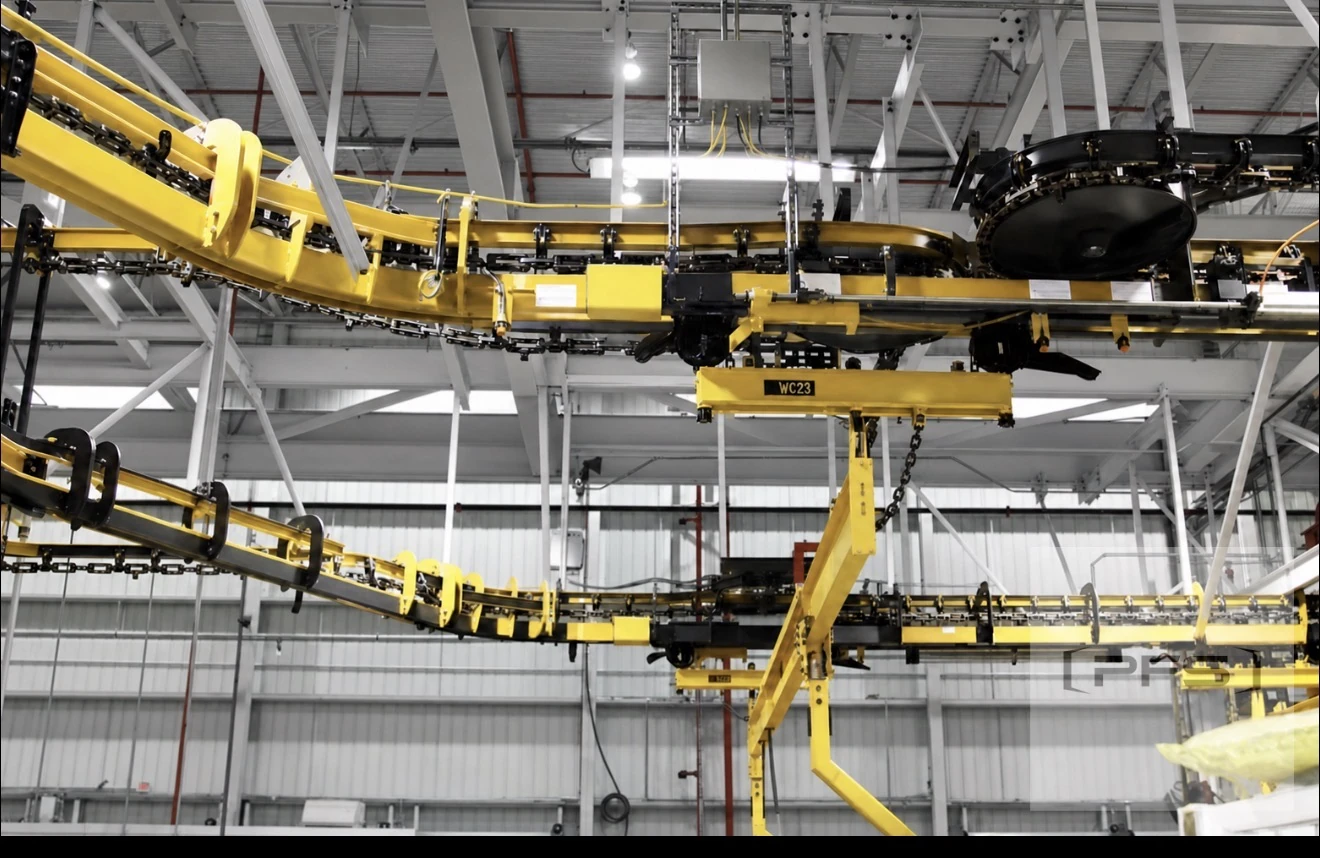
Overhead monorail, power-and-free, and floor conveyor systems for industrial finishing lines.
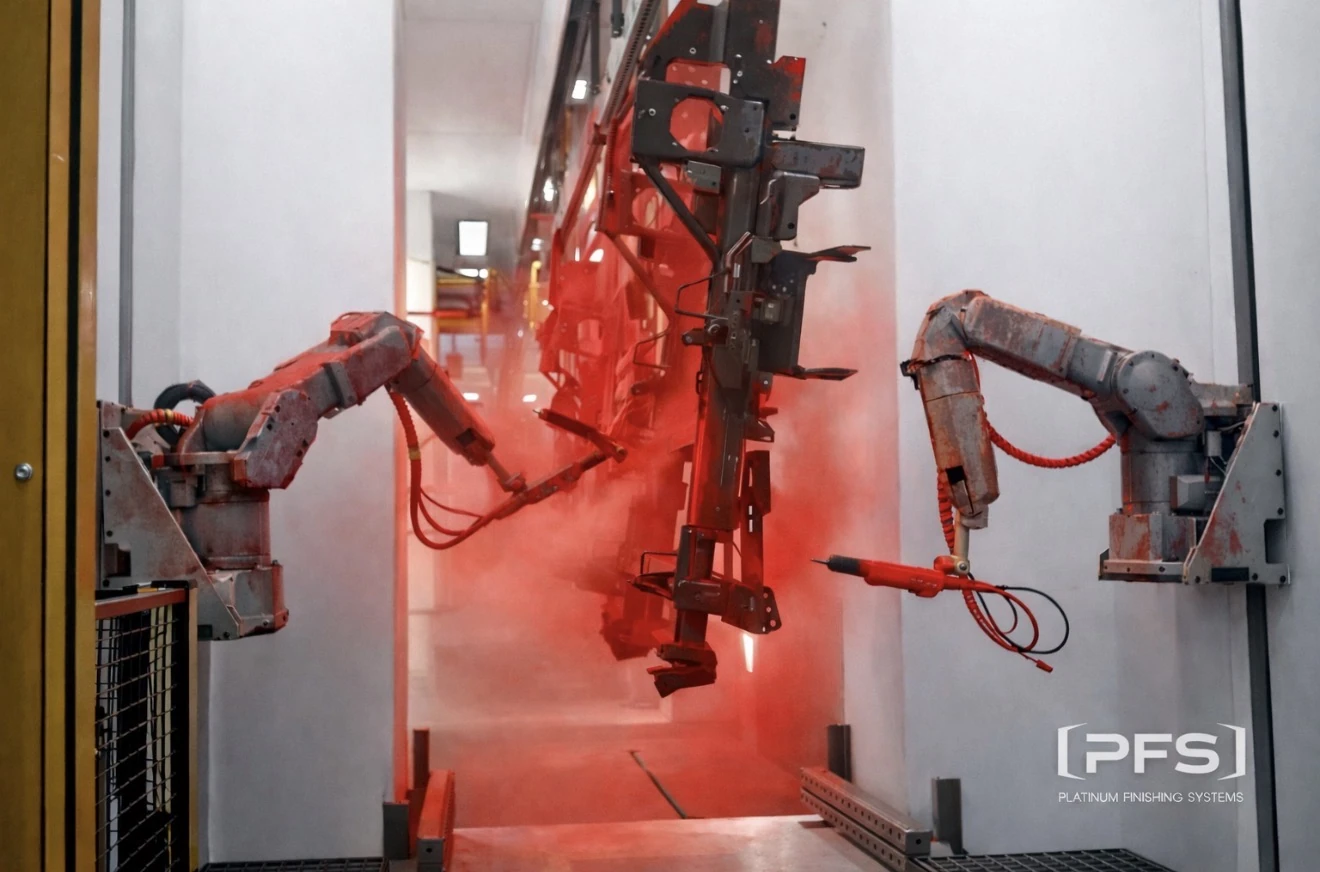
Conveyorized liquid paint lines with climate-controlled spray zones, flash-off tunnels, and curing ovens.

Complete powder coating lines: pretreatment, booth, powder recovery, cure oven, and conveyor.
Platinum Finishing Systems (PFS), a U.S. paint and finishing system integrator, integrates FANUC and ABB robots for liquid paint and powder coating cells.


