
Fully automated powder application systems integrated with conveyor lines and robotic applicators for high-volume production.


PFS automated powder coating systems integrate automatic gun movers, robotic applicators, conveyor systems, and closed-loop powder reclaim into a complete high-volume finishing line. Designed for production environments where throughput, repeatability, and transfer efficiency are the primary performance metrics. PFS engineers each automated system around your part geometry, conveyor speed, production rate, and powder chemistry — from a single automated booth to a complete powder coating line including pretreatment, application, curing oven, and conveyor. All systems are built to NFPA 33 and IFC Chapter 24 requirements and are ETL listed (Intertek) for the USA and Canada.
Parts with a stable shape where gun position, reciprocators, or robotics beat a hand gun on every cycle.
Lines that change color on a schedule and need a booth that can be cleaned without a full teardown.
Booths that have to talk to a conveyor, an oven, and the controls already on the floor.
Fixed or moving guns aimed at a known part path. The part geometry decides the gun count.
Cartridge or cyclone recovery when reclaim is worth it for the powder and the color plan.
Most automated booths still leave a station for the surfaces the guns miss. That station is designed in, not hoped for.
Automated powder booths follow the same ventilation, grounding, and fire-protection review as a manual booth, plus the machine-safety conversation for moving guns. The authority having jurisdiction and the plant’s safety review close that, not a generic certificate.
| Factor | Manual booth | Automatic guns (fixed or gun movers) | Robotic application |
|---|---|---|---|
| Best for | Low volume, high mix, large or one-off parts | Repeat parts at steady line speed | Complex shapes or a wide part mix on one line |
| Consistency | Depends on the operator | Same gun path every cycle | Programmed path per part |
| Labor | One sprayer per booth | Operators load, watch and touch up | Operators load, watch and touch up |
| Changeover | Fast; hand gun and hopper | Gun settings and stroke per part family | Program per part; can switch automatically |
| Manual touch-up | n/a | Usually planned in | Often reduced, rarely zero |
| Integration | Stand-alone or with a batch oven | Conveyor, oven and controls interlocked | Conveyor, oven, robot cell and controls interlocked |
| Code items | NFPA 33 Ch. 15 ventilation and grounding | Plus flame detection with shutdown | Plus flame detection and robot-cell safety |
Our engineers are available to help you select the right configuration for your application.
Parts ride a conveyor through the booth while automatic electrostatic guns apply powder from both sides. The guns sit on fixed stands, on reciprocators or gun movers that stroke up and down, or on robots when the part shape changes from hanger to hanger. The booth exhaust pulls overspray away from the part and into a recovery module or a filter bank, and the control panel ties gun triggering, gun motion and booth airflow to the conveyor so the guns only spray when a part is in front of them.
The result is the same film build on part 1 and part 1,000. Operators move from spraying every part to loading, watching the finish and touching up the few surfaces the guns cannot reach.
Fixed guns are the simplest choice for flat or uniform parts on a steady line. Reciprocators and gun movers stroke the guns to cover tall parts with fewer guns, and they can be programmed for different part heights. Robots earn their place when the part mix is wide, the geometry is complex or the same booth has to coat very different parts on one line. Many lines combine them: gun movers for the bulk of the surface and a manual or robotic station for the hard-to-reach areas. See the comparison table on this page and our robotic finishing cells page.
Cyclone and cartridge recovery collect overspray and return it to the feed system, which pays off on long runs of a few colors. Spray-to-waste filtration skips recovery and makes color change faster, which suits short runs and many colors. Some plants use both: a recovery booth for the high-volume colors and a spray-to-waste booth for everything else.
Color change time depends on the booth interior, the guns and hoses, the feed center and whether a recovery circuit has to be cleaned. We plan it against your real color schedule. More detail: powder reclaim systems and spray-to-waste booths.
An automated booth is only as good as the parts that reach it. Clean, dry parts from pretreatment, steady hanger spacing from the conveyor and a cure oven matched to line speed and part mass matter as much as the guns. PFS designs complete powder coating lines, including conveyor systems and conveyor ovens, so the booth, conveyor, oven and controls are sized as one system.
Daily gun cleaning, clean hooks for grounding and scheduled filter or cartridge changes keep transfer efficiency and finish quality steady. Flame detectors and interlocks need regular testing. PFS supports PFS-built and third-party systems through powder reclaim service and preventive maintenance.
Share your parts, volume and line speed. Our engineers will scope the system.


It removes repetitive gun motion. Someone still loads, watches the finish, and cleans the booth. Touch-up is normal.
Sometimes. The booth airflow, the part path, and the controls have to be able to accept the guns. We look at the existing booth before saying yes.
It depends on the powder, the booth interior, and whether reclaim is in the circuit. We time it against your real color schedule instead of quoting a single minute value.
It depends on part height, line speed and the film build you need. We lay the guns out from your part drawings and hang pattern, usually on both sides of the booth, and add manual stations where the part has recesses the guns cannot reach.
Yes. The fire code requires automated powder and electrostatic systems to have approved flame detection that shuts down the application equipment, conveyor and powder supply within half a second (IFC 2406.4.1 and 2407.4.1). PFS designs the detection and interlocks into the control panel.
Both reclaim overspray. Cyclones suit long runs and frequent color changes on a recovery line, with an after-filter to catch fines. Cartridge booths are compact and efficient for fewer colors. If colors change many times per shift, spray-to-waste may be the better fit.
Overhead monorail, power-and-free and floor conveyors all work. The conveyor sets hanger spacing and line speed, which set gun count and booth length, so we size the booth and conveyor together.
Yes. Color change is planned into the booth interior, the feed center and the recovery choice. Many plants run high-volume colors through recovery and short runs to waste or in a second booth.
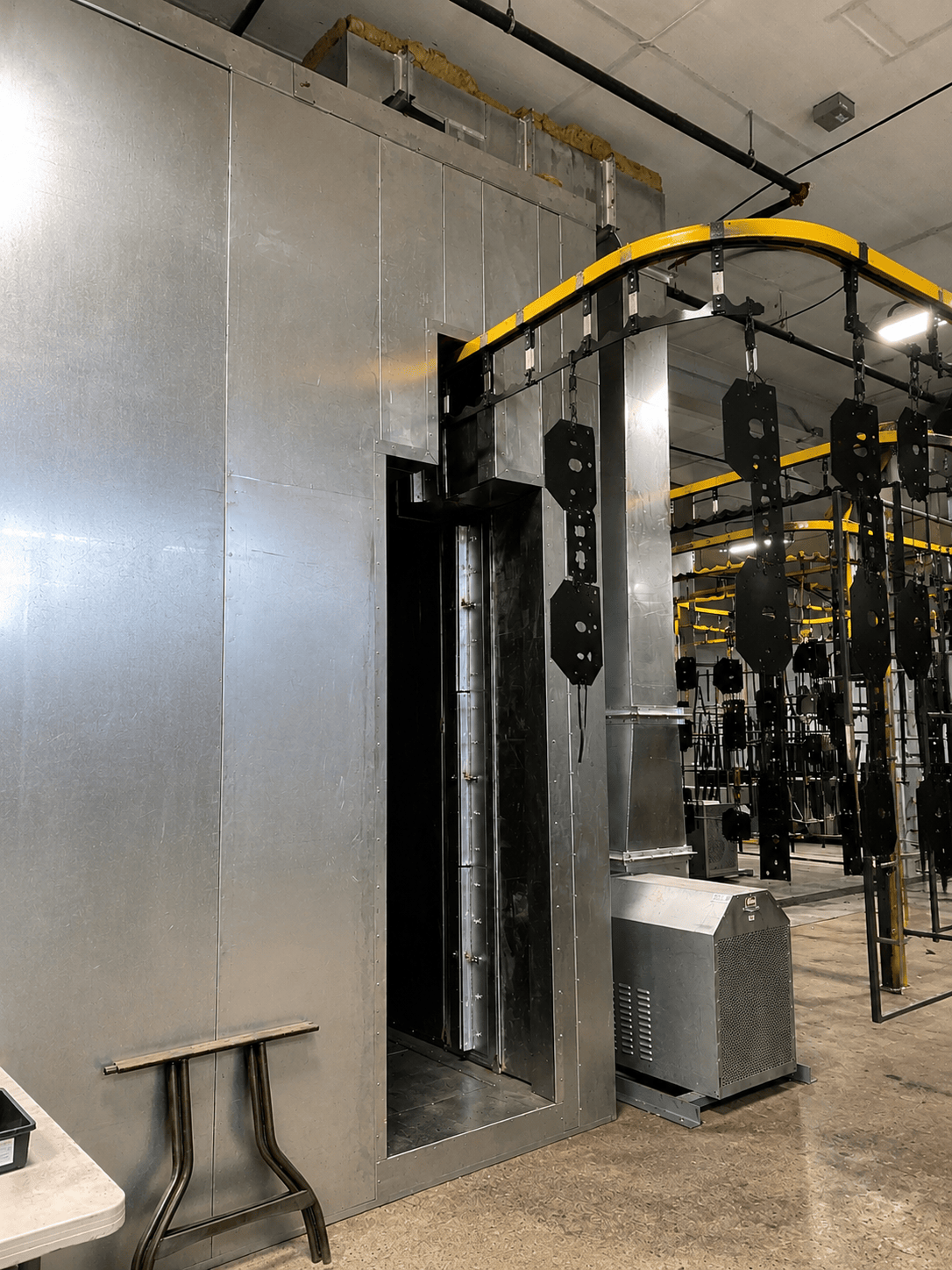
Continuous conveyor curing ovens for automated finishing lines, with multi-zone temperature control.
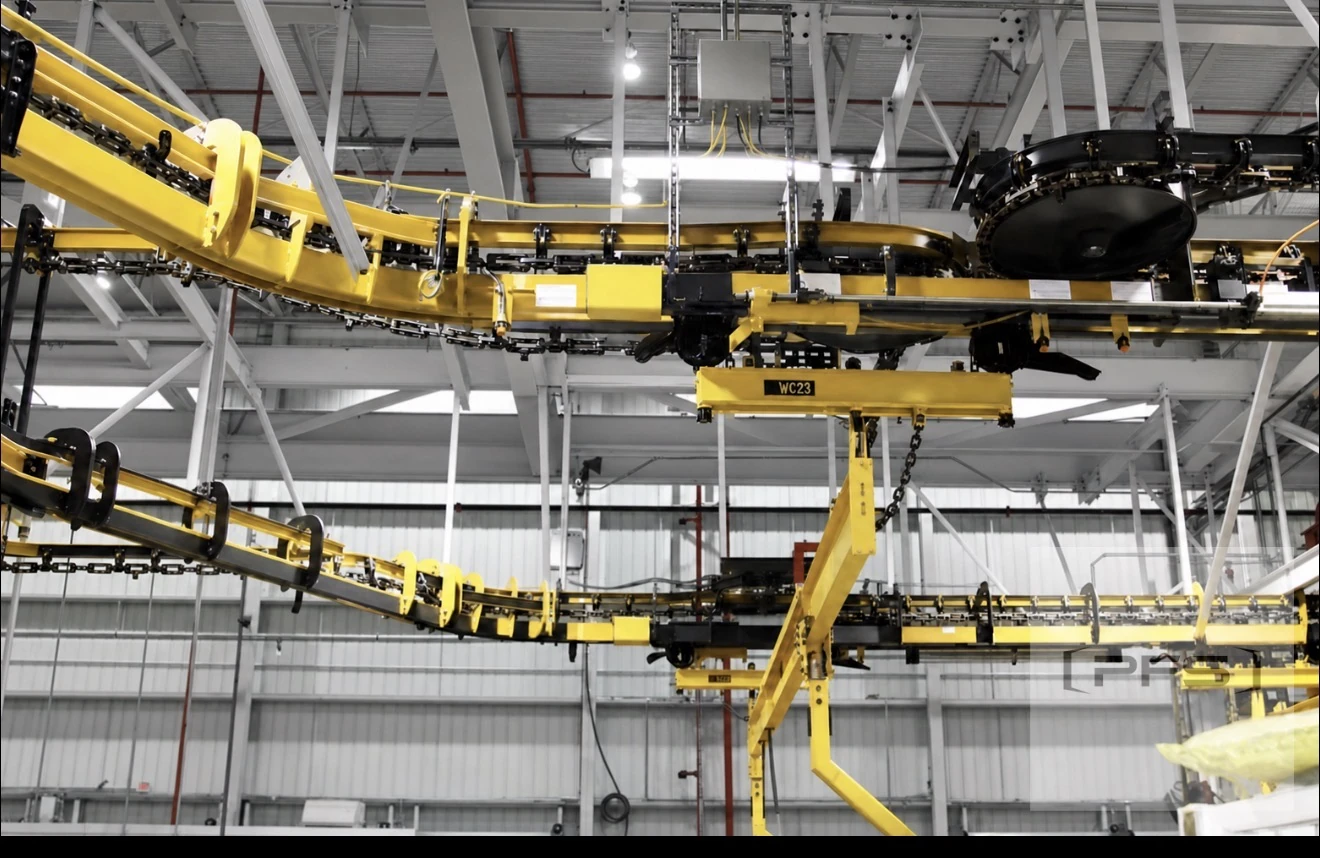
Overhead monorail, power-and-free, and floor conveyor systems for industrial finishing lines.
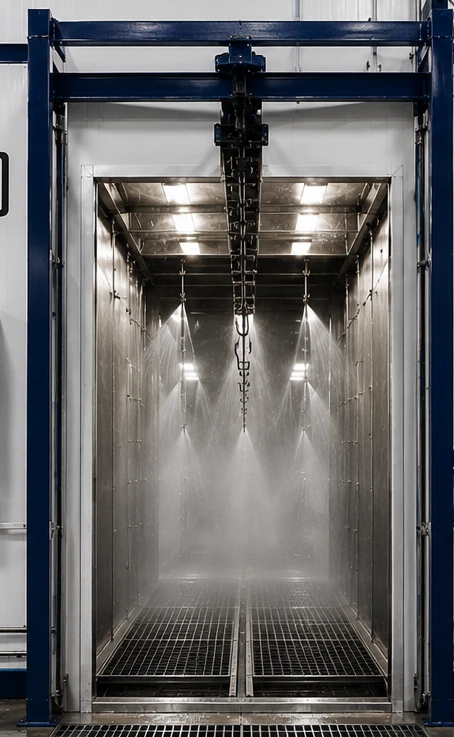
Automated chemical pretreatment systems for cleaning, phosphating, and surface prep before coating.


